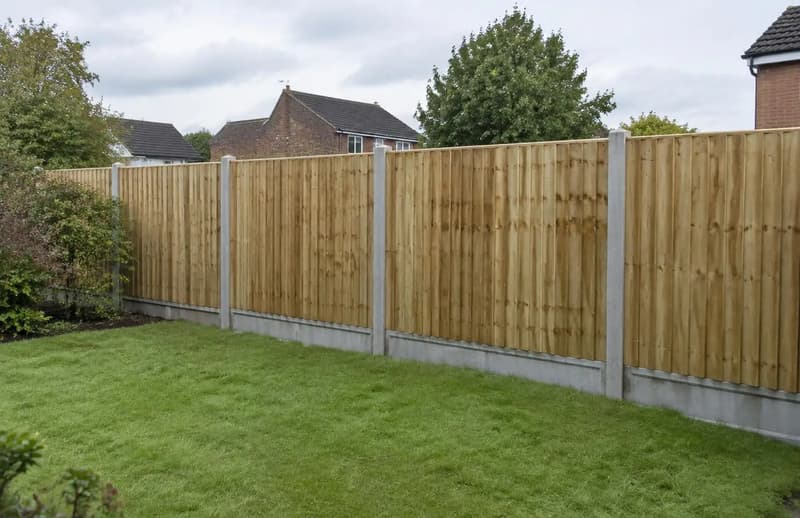
Fencing Totton: Posts and Gravel Boards on Wet Ground
Is an older Calmore or Testwood fence ready for replacement, and what support will suit its position near the Test estuary? Those are useful questions for a Totton fencing enquiry, not a diagnosis of every boundary. Ashley assesses the posts, boards and finished levels before choosing how the fence will meet the garden. The actual ground and exposure matter more than the appearance of a panel.
Free site quotationOlder estate fences beside the estuary
Totton is a town in the civil parish of Totton and Eling, New Forest district, Hampshire, not Southampton city. Calmore and Testwood have late-20th-century estates where an original fence may now need replacement. Check which parts remain sound rather than assuming its age requires a whole new run. Commercial Road identifies the town centre, while the nearby Tatchbury Mount Iron Age hillfort is another point of orientation.
The town stands at the head of Southampton Water by the Test estuary, with the A35 causeway towards Southampton. Exposure and damp conditions are worth checking at the fence line; they do not establish the soil at every SO40 address. Discuss panels suitable for the assessed wind exposure and posts set for the ground encountered. A fence is not a flood defence, and changing boards does not remedy a weak foundation.
Depth is a site decision, not an online rule
The required post setting depends on the fence, exposure and the ground encountered. This page does not give a universal digging depth. Ask how the proposed support will reach a suitable foundation and what happens if excavation reveals loose fill or an obstruction. Those details belong in the site discussion, before assuming replacement posts can be placed directly into the old holes.
Wet conditions may also affect when the work is practical. Disturbing very soft soil can complicate access and leave the surroundings harder to reinstate. Ashley can assess the boundary at the free visit and discuss the sequence, but seeing standing water is not by itself a specification for the post footing. Drainage concerns and fence support should be considered together without claiming one automatically solves the other.
Set gravel boards against the finished soil level
A gravel board forms the bottom edge beneath the fence timber. On a newer plot, think about where the lawn or border will finish before setting that edge. If topsoil is to be replaced later, the current surface may not be the final height. Marking the intended level helps avoid burying the lower timber after the fence has been fitted.
Soil pressure from a higher bed is a separate issue. Gravel boards should not be treated as a convenient retaining system just because they close a gap under the panels. Explain any difference in levels across the boundary and obtain appropriate advice where soil needs retaining. The visible lower edge should answer the actual garden arrangement, not conceal an unresolved change of ground height.
Boundary length, ownership and replacement choices
Across New Forest district, 45.4% of homes are detached, 24.1% semi-detached and 15.3% terraced. Detached-heavy housing makes longer boundary runs relevant to the enquiry, but the figures are not Totton-only measurements. Walk the whole line and mark the parts that lean, have damaged timber or meet a change in level. Retaining a sound stretch may be possible if its supports work with the proposed replacement.
Across New Forest district, 74.2% of homes are owner-occupied. Ownership of the home does not settle ownership of a particular fence, so agree the boundary and any neighbour access before removal. The panel-versus-closeboard guide explains material choices, and the main fencing hub retains the existing prices. Send Ashley the SO40 address, fence length and carrying route, then agree the removal and reinstatement included in the free site quotation.
Common questions
Questions about fencing totton: posts and gravel boards on wet ground
Should an original Calmore or Testwood fence be replaced all at once?
Not simply because it is older. Inspect the posts and each stretch, then decide whether retained sections can join reliably to the new work. Age is context, not a specification for replacement.
What should an estuary-facing Totton boundary enquiry include?
Describe the fence’s exposure, movement and any damp ground at the supports. Ashley can assess suitable panels and post settings without treating every garden near the Test as having identical conditions.
Does an SO40 address establish who owns the fence?
No. The postcode locates the enquiry, not the legal boundary. Check ownership and any access agreement with the neighbour before deciding which supports or panels can be removed.