Southampton and within 20 miles
Artificial Grass Installation in Southampton
Artificial grass installation needs more than a roll of grass and a tidy edge. The proposed surface depends on excavation, a stable foundation and somewhere for rainwater to go. This is an enquiry option whose scope Ashley confirms at the site visit, not a claim of completed artificial lawn projects.
Planned for your property
A sound foundation and a finish that belongs
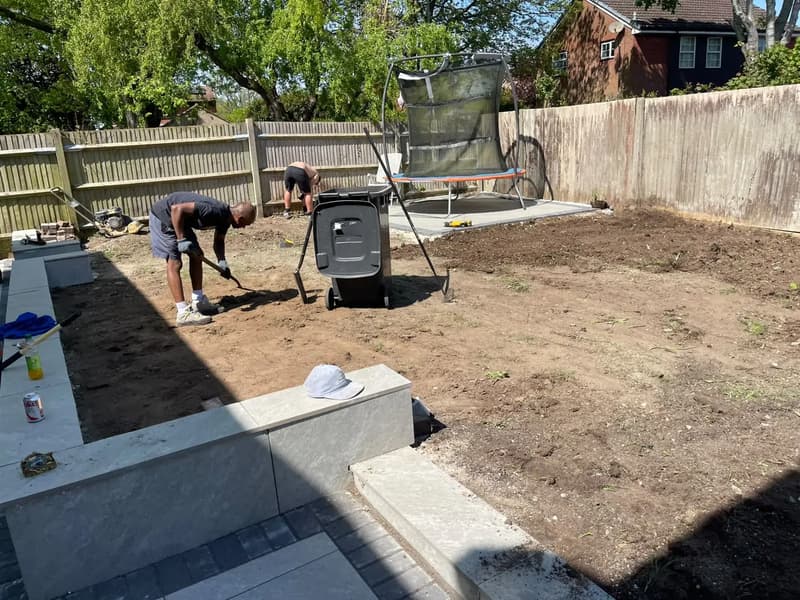
Think of artificial turf as the finish of a ground preparation job. Uneven soil, trapped moisture and unsupported edges remain problems even when hidden under a new surface. Before choosing a grass grade, establish how the area will be used, where its finished level belongs and how it meets paths or paving. The photograph is ground preparation context only, not an AJ artificial grass installation.
Ashley stays closely involved from the first conversation to the final tidy-up, so you always know who is responsible for your project.
What you can expect
- Groundwork assessed before a surface is chosen
- Edges and adjoining levels considered together
- Drainage suitability checked for the actual ground
Removing an existing lawn
Putting artificial grass directly over living turf leaves an unstable layer beneath it. Roots, vegetation and soft topsoil can break down or move, producing hollows that show through the finish. The condition of the ground determines how much needs removing; a thin skim is not automatically enough, and there is no universal excavation depth that suits every garden.
Existing tree roots, buried rubble and service routes also matter. Discuss anything you know about the ground before excavation is proposed. If the garden needs reshaping rather than simply resurfacing, garden levelling should be considered first so the new outline does not preserve an awkward slope or dip.
Sub-base, finishing layer and edging
A stable, compacted foundation supports the surface and spreads everyday loads. Above it, the finishing layer needs to suit the grass system rather than being chosen only because it is easy to rake flat. Materials and layer depths should follow the site assessment and installation specification. Soft corners and unrestrained edges can move independently of the centre.
Perimeter detailing holds the outline and gives the grass a secure termination. Curves, narrow strips and changes beside a patio require more careful cutting and fixing than a simple rectangle. Plan joins so they fit the layout, with pile direction considered across adjoining pieces. These decisions belong in the installation discussion, not only in product shopping.
Heavy clay and rainwater
A porous backing does not make heavy clay absorb water more quickly. Rain still has to pass through the prepared layers and reach a suitable destination. Where water already stands after rain, covering the lawn can conceal the symptom without addressing the cause. Any drainage provision must be assessed for the ground and nearby buildings.
Explain whether the wet patch is permanent, seasonal or appears only during downpours. Photos taken after rain are useful alongside the dry-weather visit. Do not assume a new surface will cure a waterlogged garden, and do not accept a discharge route that sends the problem towards a neighbour or the house.
Artificial grass or a living lawn?
Artificial grass avoids mowing, but it still needs cleaning and debris removal. Natural turf is a living surface with different watering, mowing and soil requirements. The best choice depends on how you use the garden rather than a promise of no maintenance. Our turf or seed guide explains the living-lawn alternatives without turning this installation page into a catalogue.
For an artificial grass company near you, start by asking about the proposed groundwork and how the edges will be finished. Ashley is Southampton based and carries out his work himself from quote to finish; the artificial grass scope must be agreed before you treat it as a confirmed installation booking.
Discuss this as part of the wider garden
Bring the proposed lawn into the garden redesign discussion, with circulation and other surfaces planned before materials are ordered. For an uneven starting point, also read the garden levelling page.
Pricing
What shapes the quotation?
There is no published artificial grass price on this site. A quotation depends on the measured area, excavation, replacement base, perimeter detailing, waste handling and the chosen grass specification. Poor access can change the work involved even on a small lawn. Ask for the proposed preparation and any drainage allowance to be written down so you know which tasks the quotation covers.
Timescales
Decisions before the work starts
Inspect
Identify the existing surface, weak spots and wet areas before discussing materials.
Set levels
Agree how the lawn joins the surrounding paths, doors and paving.
Specify preparation
Discuss excavation, foundation and perimeter support for this particular plot.
Confirm scope
Agree what can be undertaken and what further drainage advice may be needed.
Guides
Helpful reading before you commit
Artificial Grass Installation Cost: What to Allow For
Read the artificial grass installation cost guide before settling the details of this project.
Read the guide ComparisonsTurf vs seed: which is right for your new lawn?
Read the turf or seed new lawn guide before settling the details of this project.
Read the guideCommon questions
Artificial Grass Installation: your questions answered
What base goes under artificial grass?
A stable prepared foundation and compatible finishing layer are normally required. The ground, expected use and grass system determine the specification; one material or depth is not right for every plot.
Will artificial grass drain on heavy clay?
Not automatically. The backing may pass water, but clay underneath can still hold it. The visit needs to establish whether a suitable drainage arrangement is possible.
Can artificial grass go over an existing lawn?
Covering living turf is generally unsuitable because the vegetation and soft soil can deteriorate underneath. Removal and preparation should be assessed before fixing the new surface.
Plan ahead
Book winter groundwork so your garden is ready for spring
Autumn and winter are useful times to tackle digouts, levelling, fencing and foundations. Get the preparation done before the days get longer.
Areas covered
Local landscaping within 20 miles
Ready to improve your garden?
Arrange a free site quotation with Ashley.