Southampton and within 20 miles
Close Board Fencing in Southampton
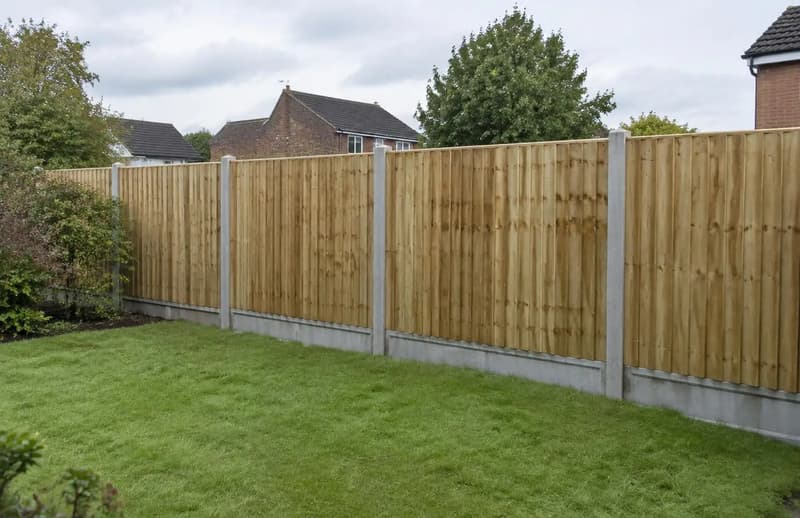
Close board fencing is built piece by piece on site, from posts, rails and overlapping featheredge boards, so it follows your boundary exactly and stands up well on exposed runs.
Planned for your property
A sound foundation and a finish that belongs
Unlike a panel fence, nothing about a close board fence is made to a fixed width in a factory. Ashley sets the posts, fixes the rails and boards to suit the actual line of your boundary, which is why it copes so well with slopes, corners and odd lengths.
Ashley stays closely involved from the first conversation to the final tidy-up, so you always know who is responsible for your project.
What you can expect
- Built in place to follow slopes and corners
- Concrete or timber posts to suit the run
- Gravel boards keep timber off damp soil
- Capping rail finishes the top edge
What a close board fence is made of
A close board fence has four parts. The posts carry everything and are set into the ground. Horizontal arris rails run between the posts and take the fixings. Featheredge boards, thicker on one edge than the other, overlap each other down the run so there are no gaps. A gravel board along the bottom lifts the boards clear of the soil, and a capping rail along the top sheds water and tidies the line.
Because each part is separate, the fence can be repaired in pieces. A split board or a failed rail is a small job, not a new fence. If your existing fence has isolated damage, the fence repairs page covers that kind of work.
Where close board fencing suits best
Close board is the usual choice for back garden boundaries where privacy matters, for gardens that catch the wind, and for any run that is not a neat multiple of a panel width. It also suits older plots where the boundary line wanders, because the fence is built to the line rather than the line having to suit the fence.
For a quick like for like renewal on a straight, sheltered run, panels can be the faster answer. The main fencing page covers both approaches and how Ashley helps you choose between them on the site visit.
Keeping a close board fence standing longer
The life of a close board fence is decided at ground level. Timber boards that touch soil stay damp and rot from the bottom up, which is why a gravel board along the base is standard practice rather than an extra. When a board eventually fails, it is the gravel board that has taken the wear, and replacing one board is a small job.
Posts are the other half of the story. A fence that leans has almost always failed at the posts, not the boards, so the depth they are set and what they are set in matters more than anything above ground. Ashley talks through the post choice for your ground on the site visit.
Pricing
What affects the cost of close board fencing?
Close board fencing is priced after a site visit, because the length, the ground and the access move the figure more than anything else. The main things Ashley looks at are the total run and height, whether posts go into soft soil or need digging out of old concrete, the choice of concrete or timber posts and gravel boards, and how much old fencing has to come down and be taken away. The fence installation cost guide explains how fencing is priced in more detail.
Timescales
How a close board fence goes up
Setting out
Old fencing removed, the boundary line agreed and post positions marked.
Posts
Posts dug in and set, checked for line and height before anything is fixed to them.
Rails and gravel boards
Arris rails fixed between posts and gravel boards fitted along the bottom.
Boards and capping
Featheredge boards fixed with an even overlap, then the capping rail finishes the top.
Guides
Helpful reading before you commit
Fence panels or closeboard: which suits your garden?
Choosing between a panel fence and a close board build? This guide sets out where each one wins.
Read the guide ComparisonsConcrete vs timber fence posts
The posts decide how long the fence stands. Compare concrete and timber before you choose.
Read the guideCommon questions
Close Board Fencing: your questions answered
How long does close board fencing last?
A well built close board fence on sound posts should serve for many years. The posts and gravel boards matter most: keeping timber boards off the soil and choosing concrete posts where the ground stays wet both extend the life considerably.
Is close board fencing stronger than panels?
On exposed runs, usually yes. Because it is built in place with rails and overlapping boards, there are no large panel faces to catch the wind, and a single damaged board can be swapped without replacing a whole section.
Can close board fencing follow a sloping garden?
Yes, and this is where it beats panels. The boards are fixed one by one, so the fence can step or run with the slope without leaving gaps at the bottom.
Concrete or timber posts for close board fencing?
Both work. Concrete posts resist rot and suit damp ground; timber posts cost less and some people prefer the look. Our guide to concrete and timber fence posts goes through the trade offs.
Plan ahead
Book winter groundwork so your garden is ready for spring
Autumn and winter are useful times to tackle digouts, levelling, fencing and foundations. Get the preparation done before the days get longer.
Areas covered
Local landscaping within 20 miles
Ready to improve your garden?
Arrange a free site quotation with Ashley.